Remote-control claims versus evidence gaps
Patent, QF-16, Teso FMS proof-of-concept · installation on 9M-MRO still open
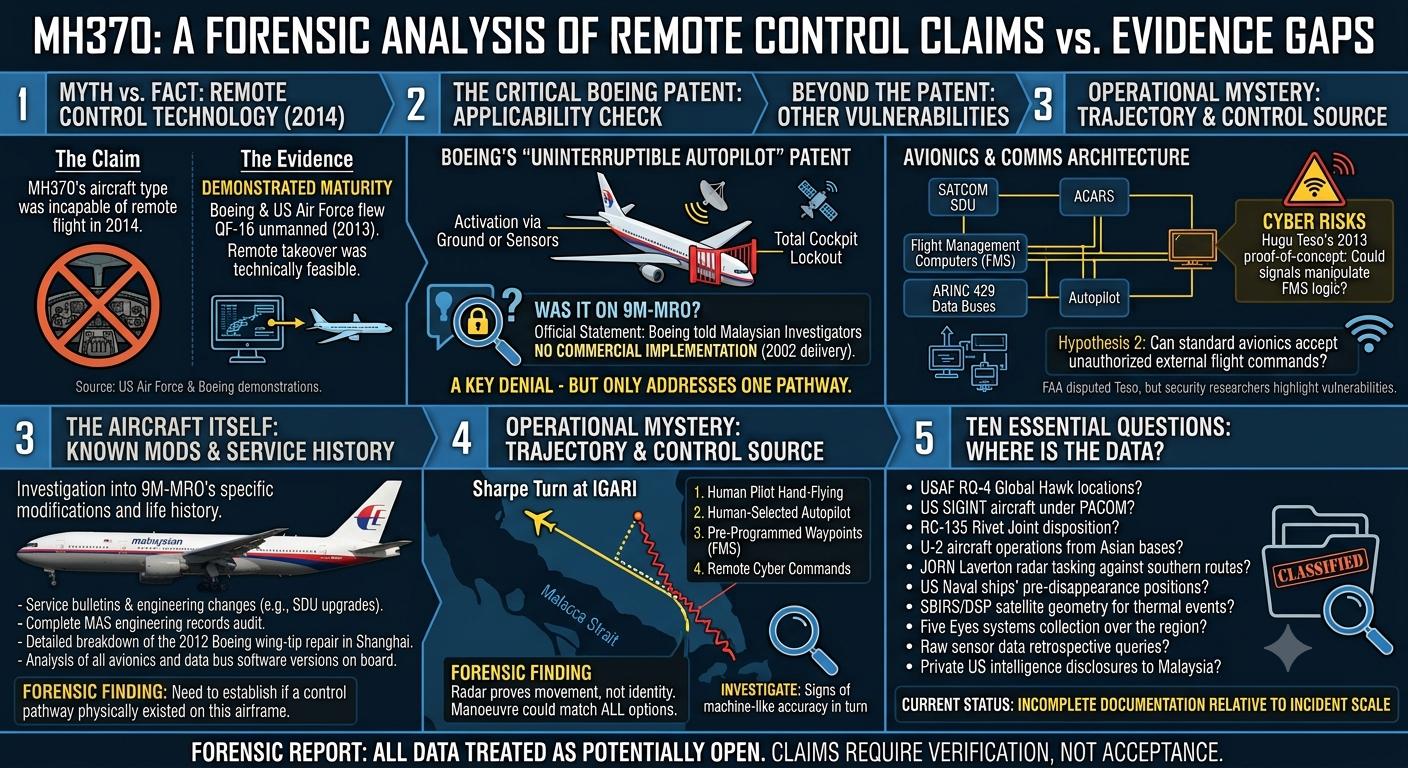
Working chart: unmanned flight of a fighter-class jet was demonstrated in 2013; Boeing’s uninterruptible-autopilot patent exists; Hugo Teso showed an FMS proof-of-concept the same year. Boeing told Malaysian investigators there was no commercial implementation on the 2002 delivery. Radar proves a turn at IGARI, not who commanded it. Ten data requests remain.
Five panels. (1) The claim that a 2014 777 could not be flown remotely sits next to a demonstrated fact: Boeing and the USAF flew QF-16 as an unmanned full-scale target. That is maturity of a different airframe, not fitment on 9M-MRO. (2) US7142971B2 describes remote engagement, dedicated comms, cockpit lockout and automatic landing at a predetermined — including military — site. Official language to the Annex 13 team was that this was not implemented on commercial aircraft at delivery. That denial addresses one pathway. (3) Standard avionics (SDU, ACARS, FMS, ARINC 429, autopilot) are the other pathway. Hugo Teso’s 2013 Hack in the Box work showed that FMS logic could be manipulated in a research setting; FAA disputed operational risk; the gap is whether 9M-MRO’s specific buses and software accepted an unauthorised external command. (4) Service history still to rebuild: SDU upgrades, MAS engineering records, the 2012 Shanghai wing-tip repair, avionics and data-bus software versions. (5) Radar at IGARI proves movement and a sharp turn, not identity of the flying agent — human, selected autopilot, pre-programmed FMS, or remote command could all draw a similar path. The board’s status line: incomplete documentation relative to the scale of the incident.
Sources
- Investigation working chart, 20 Sep 2026
Related
Boeing US7142971B2 — uninterruptible automatic control
Remote engagement · disconnected onboard controls
Cubic US6641087B1 — anti-hijack remote pilot
Commercial retrofit · satellite relay · cockpit exclusion
Boeing / USAF QF-16 unmanned full-scale demonstration, 2013
Pilotless fighter-class jet · not a 777 and not 9M-MRO
Hugo Teso, 2013 — FMS proof-of-concept
Hack in the Box · research demonstration, not a 9M-MRO finding
External / uninterruptible autopilot on 9M-MRO
Engineering precedent exists. Installation on this airframe is not established.
Did 9M-MRO have any path for external flight-control commands?
What was actually fitted on 9M-MRO — SDU, FMS, data buses, 2012 Shanghai repair?
Boeing–NAVAIR delivery order signed 4 March 2014
$955,853.54 · N0001914D0012 · engineering/technical support · St Louis
Forensic evidence board — facts, capabilities, missing dossiers
Working chart of intersections · ten target records still outstanding
The radar story and the 9 March cyberattack
Working chart · tracks, delays, and a spear-phish of the investigation