Resources
Resources
Official papers, films, Wikipedia and its citations, programmes, claims and open questions.
48 hits
Last primary radar contact
18:22:12 UTC
The final military primary-radar return is recorded northwest of Malaysia, over the Andaman Sea approaches. After this, only the satellite terminal speaks.
Last voice contact
17:19:30 UTC · “Good night Malaysian three seven zero”
Lumpur Radar transfers MH370 to Ho Chi Minh. The reply — attributed to the captain — is the last recorded voice transmission from the flight.
The last radio call is attributed to the captain
Official voice identification. Calm, protocol-correct handover two minutes before transponder loss.
Handshake 6 — last successful hourly ping
00:10:58 UTC 8 March
The last completed ground-initiated handshake. Eight minutes later the aircraft sends a log-on associated with fuel exhaustion.
Orion flight 18 — 80-hour record with 1,000 lb ballast
December 2014 · not an ISR-payload demonstration
Aurora’s endurance attempt was flight 18 and carried 1,000 lb of ballast. Maiden flight (no mission system) and this record flight both fail as evidence of an operational ISR stack. Payload on flights 2–17 remains open.
Freescale last presentation — gyroscopic sensors
Plate from the 18 September 2026 collage: pages of a Freescale presentation on gyroscopic sensors, identified as among the last formal materials before twenty employees boarded MH370.
Last ACARS transmission
17:07:29 UTC
The final Aircraft Communications Addressing and Reporting System message leaves 9M-MRO. Expected reports at 17:37 and 18:07 never arrive.
Andaman Sea / last primary radar
18:22:12 UTC
Final military primary return, northwest of Malaysia. After this, only SATCOM.
Blelly & Marchand: last log-on is not necessarily a straight dive
Independent paper used by Mentour: right-engine flame-out, APU start, cross-feed, possible eastward or gliding end. BFO steep-descent figures can be read as a manoeuvre, not only as a wreck on the arc.
Orion 80-hour remotely controlled flight
December 2014 · 1,000 lb ballast · fuel for ~37 more hours
Contractor-confirmed endurance after MH370. This was flight 18 and carried 1,000 lb of ballast. Shows the air vehicle matured; does not rewind payload status to March.
Aurora Orion RPA
Twin-diesel MALE UAS · China Lake first flight 24 Aug 2013
Selected air vehicle for MAGIC: a multi-day, medium-altitude remotely piloted ISR platform designed to carry multiple sensors. First flight (24 Aug 2013) had no mission system; the December 2014 endurance record carried ballast. Those two flights do not decide what was fitted on sorties 2–17, including March 2014.
BD764 and BE144 — named radar feeds, and a gap after 18:02:59 UTC
Secondary ends with the transponder · primary westbound · later points still to source
The working chart labels two Malaysian Air Defence datasets: BD764 (secondary, 10-second intervals, early flight, ends 01:21 MYT with the transponder) and BE144 (primary, 10-second intervals, westbound after the turn, ends 18:02:59 UTC). The 2018 reconstruction then shows a last military return at 18:22:12 UTC after a gap. Those later points exist in the official track. Their raw source is not public.
Blue Devil, MAGIC, Orion, BIG SAFARI — 2014 window
Briefing collages, 18 September 2026
Nic Moneypenny published investigation collages placing Blue Devil (including an egg-shaped airship), MAGIC, Aurora Orion, BIG SAFARI, Lockheed and DARPA in the same 2013–14 spending window as MH370, with Freescale’s last gyro presentation among the plates.
Fariq Abdul Hamid
First officer · MH370
Not heard on the last ATC handover. His mobile registered with a Penang tower at 17:52:27 UTC, corroborating the westbound primary-radar track. About 2,763 hours; this was a 777 training sector.
Malaysia Airlines declares the flight missing
23:24 UTC
The airline issues a public statement that MH370 is missing, hours after radio and radar contact were lost and while the aircraft is still exchanging satellite handshakes.
Orion’s first flight carried no mission system
Confirmed by contemporary September 2013 reporting and consistent with PB2015’s FY2014 “best of breed” sensor-selection language. December 2014 endurance attempt was flight 18 with 1,000 lb ballast — also not an ISR-payload demonstration. Those two flights do not decide what Orion was, and they do not decide March 2014.
Wikipedia timeline — night of 7–8 March 2014
Duty sign-in through failed 09:15 handshake
Compiled public chronology: captain sign-in 22:50 MYT 7 March, F/O 23:15, SDU log-on 00:00, push 00:27, takeoff 00:42, FL350 01:01, last ACARS 01:07, last voice 01:19:30, transponder 01:21:13, Penang cell 01:52, last radar 02:22, SDU log-on 02:25, hourly pings, last transmission 08:19:37, no reply 09:15.
Zaharie Ahmad Shah
Pilot in command · MH370
Last attributed radio call: “Good night Malaysian three seven zero.” Home simulator files exist; the 2018 report did not treat them as a reconstructed plan. Who was flying after IGARI is open.
Capt. Patrick Blelly & Jean-Luc Marchand
Independent trajectory paper
End-of-flight reconstruction used by Mentour: flame-out, APU, cross-feed, possible glide. Argues the last BFO need not be a wreck on the 7th arc.
Gulf of Thailand / South China Sea search
Wrong-ocean SAR · 8–14 March 2014
Where the aircraft was last seen on civil radar — and where it no longer was.
Inmarsat
Classic Aero I-3 · Perth Ground Earth Station
The communications company that became the principal witness to MH370’s last six hours.
Raytheon MTS-B as Orion payload lead
Reported option · 2012–13 USAF UAV MTS bookings in the $200m class
MTS-B is EO/IR FMV/targeting. Aviation Week 2010 attributed a planned pair of MTS-B turrets on Orion — planned, not fitted on the maiden article. Flight 18 (Dec 2014) carried 1,000 lb ballast. Raytheon 10-K totals do not identify Orion as the customer.
RMAF notifies KL ARCC of the western military track
22:30 MYT 8 March 2014 · ~12 hours after the minister
SAR chronology: civilian rescue centre informed of the possible turn-back / western last-known at 22:30 Malaysian time. Ministerial awareness ~10:30. The gap is a documented information-latency issue, not by itself a finding of a cover-up.
Satellite data unit logs back on
18:25:27 UTC · Handshake 1
Three minutes after the last radar paint, the aircraft SDU sends a log-on request to Inmarsat. Investigators treat this as a power restoration to the SATCOM avionics.
The 18:25 log-on follows a SATCOM power interruption
Official: aircraft-initiated log-on three minutes after last radar is most likely SDU power restore. Why power was lost is unknown.
The 7th arc
00:19:29 UTC aircraft-initiated log-on
BTO range ring at the last transmission. Official and Ocean Infinity boxes are arguments about a segment of this arc plus a stand-off. It is not a crash pin.
Waypoint IGARI
FIR boundary · Gulf of Thailand
Last secondary-radar / planned-route point. Transfer to Ho Chi Minh failed.
West-track disclosure lag — ministerial 10:30, ARCC 22:30, Thai 9–10 days
8 March and 18–19 March 2014
Hishammuddin 1 May 2014: military radar playback ~08:30 MYT 8 March, Air Force ops ~09:00, minister informed ~10:30 of a possible turn-back; a military aircraft west at 10:54. KL ARCC was not informed by RMAF of the western last-known until 22:30 MYT — a roughly 12-hour operational gap. Thai Surat Thani radar disclosed 18–19 March.
What sensors were actually on Orion by March 2014?
Orion was selected as MAGIC’s multi-day, multi-sensor ISR aircraft. First flight had no mission system; flight 18 (Dec 2014) carried ballast. Those two points do not empty the aircraft. Sorties 2–17, including March 2014, are the hole. Gorgon Stare / MTS-B / VADER remain live leads, not closed fits.
What was on Orion flights 2–17 between August 2013 and March 2014?
First flight: no mission system. Flight 18 (Dec 2014): ballast. The MH370-relevant interval is the unlisted sorties in between, plus whether the ‘second flight series’ PB2015 said was being scheduled had begun by 8 March.
A NEW Trace! The FULL MH370 Story, so Far
Mentour Pilot · Petter Hörnfeldt · 16 March 2024 · 56:06
Type-rated 737 captain’s reconstruction from the 2018 report, Inmarsat BTO/BFO, and the Blelly–Marchand end-of-flight paper. Argues the transponder was selected off in two steps, not failed as a unit. Closes with a WSPR lead and a request to restart the search.
BTO range rings and BFO Doppler residuals
Inmarsat / Ashton et al. · Journal of Navigation
Burst Timing Offset describes distance from the satellite (an arc on the Earth). Burst Frequency Offset encodes relative motion and is why official analysis went south, not north.
Controlled descent / ditching
Someone still flying at the end
A pilot or system flies a glide after flame-out, so the wreck lies tens of kilometres from the 7th arc. Flaperon damage is read by some independent engineers as consistent with a ditching sequence.
Inside the Investigation: The Search for MH370 Truth
7NEWS · Peter Foley, Joe Hattley
Former lead search officials on internal protocol, sonar-mapping mistakes, and why a debris field can still be found. An Australian operational view, not a cockpit narrative.
Is Flight 370 still sending signals?
CNN · 13 March 2014 · 2:09
Week-one report, before the 15 March Inmarsat southern-arc briefing. Captures the live confusion over whether the aircraft was still electrically alive.
Is the public ACARS log missing a block of messages?
Jericho 2019 attributes a ~26-minute exclusion in the released ACARS traffic log and an ACARS-unavailable window of roughly 22–78 minutes. Needs a line-by-line check against the MOT 2015 Factual Information ACARS appendix.
Malaysia announces the southern Indian Ocean track
15 March 2014
Prime Minister Najib Razak states that new satellite data show MH370 flew for hours into the southern Indian Ocean. The search pivots.
Malaysian military primary-radar track
17:21–18:22 UTC · westbound after IGARI
Primary radar paints a left turn off the Beijing airway, a crossing of the peninsula, and a track up the Strait of Malacca until 18:22 UTC. Altitude/speed blip-to-blip in the file are noisier than 777 performance.
Second unanswered sat-phone call
23:13:58 UTC
Another ground-to-air telephone call is acknowledged by the SDU and unanswered in the cockpit.
Secondary radar lost
17:21:13 UTC
Mode S transponder returns cease. Primary (military) radar continues to paint an unidentified westbound track consistent with MH370.
Surface search begins in the South China Sea
8 March 2014
Ships and aircraft search the Gulf of Thailand / South China Sea along the filed route — the wrong ocean for several days.
The Debris Swarm
Jeff Wise · Finding MH370 S1E19 · 15 November 2024 · 39:26
After six months with only the Réunion flaperon, a cluster of western-Indian-Ocean pieces appears in 2016. CSIRO reverse-drift and barnacle work are the scientific spine; the swarm’s timing is the puzzle Wise keeps open.
The radar story and the 9 March cyberattack
Working chart · tracks, delays, and a spear-phish of the investigation
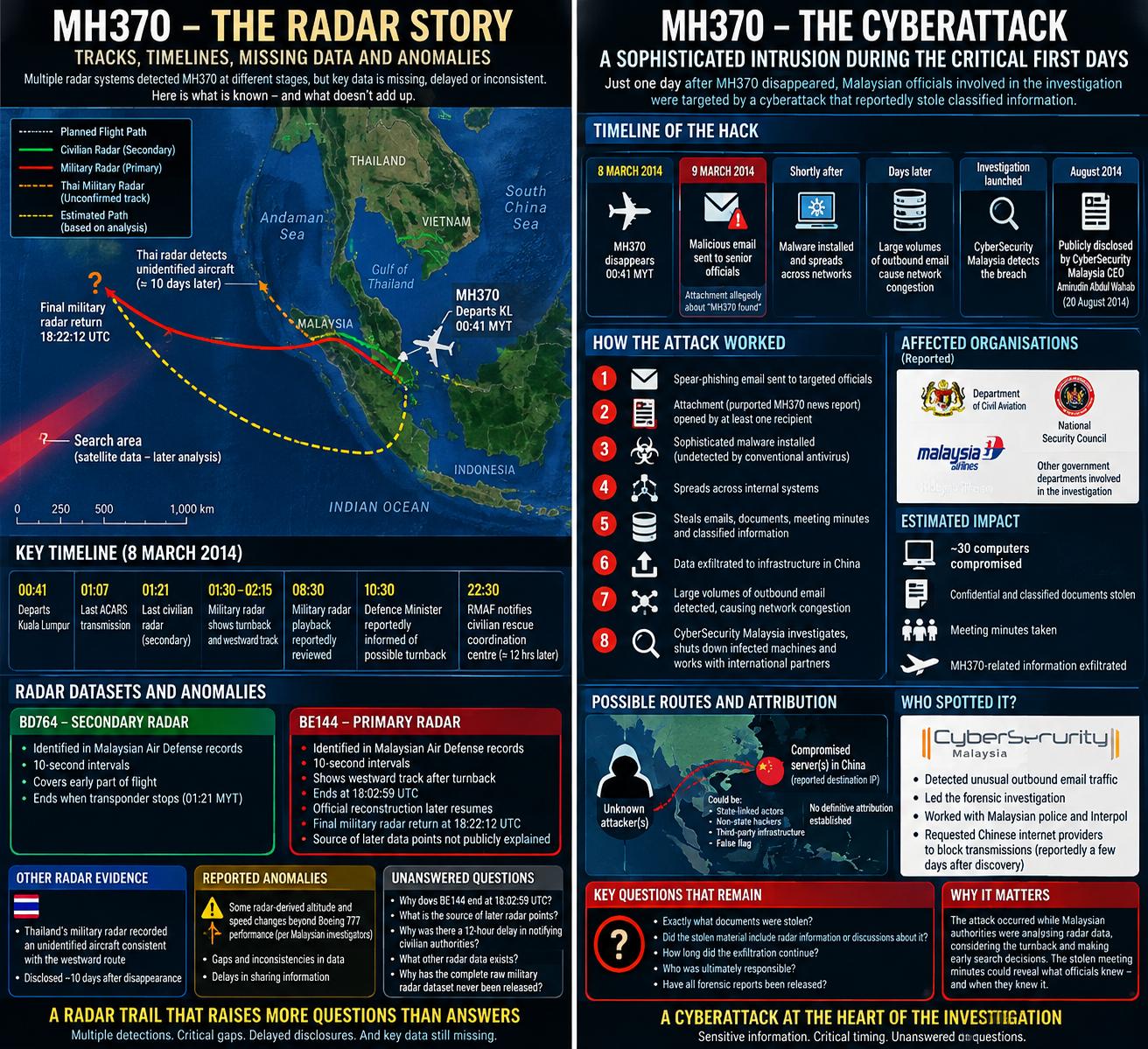
Two panels. Left: civilian secondary, Malaysian military primary, Thai paint disclosed ten days later, and the 12-hour lag before the civilian rescue centre was told. Right: one day after the loss, officials on the investigation were hit with a spear-phish that CyberSecurity Malaysia later said stole classified material toward an IP in China. Presence of a hack is confirmed as that agency’s public account. What was in the take — and whether it included radar — is still open.
The Search for MH370 — Journal of Navigation
Ashton, Dickinson, Hall, Roberts, Smith · Inmarsat · 2014/15
The paper that showed how BTO and BFO from routine signalling units can reconstruct a long flight the airline did not know it still had.
USS Pinckney (DDG 91) diverted from South China Sea training to search
7th Fleet · 8 March 2014 · two MH-60R embarked
Confirmed. Pinckney was already at sea in the South China Sea on a training and maritime-security task, then ordered toward Vietnam’s southern coast after MH370 was missing. Helicopters flew search sorties from 9 March. Pre-search combat-system logs are not public.
Waypoint IGARI
17:20:31 UTC
MH370 passes IGARI, the FIR boundary between Kuala Lumpur and Ho Chi Minh, seconds before disappearing from secondary radar.
Wikipedia — Malaysia Airlines Flight 370
en.wikipedia.org · living page · read 18 September 2026
Crowd-maintained digest of the public case: 239 dead, 9M-MRO, 8 March 2014, KUL–PEK, cause undetermined. Useful as a citation map into ATSB, MOT, Inmarsat and Ocean Infinity. Not a primary source.
WSPR anomaly set (Godfrey)
Ham-radio SNR disturbances offered as a track · unverified
Richard Godfrey reports ~130 disturbances over the southern Indian Ocean, currently terminating in a 30 km-radius circle near 29.128°S 99.934°E. Not an official sensor. Not peer-reviewed.
273 records in the file.